For folks who really do have everything, here’s something you don’t see every day – a contemporary home dreamed up by Daniel Libeskind, the designer of such high profile projects as the Jewish Museum Berlin and the master plan for the World Trade Center site.
With dramatic sharp, pointed angles, expansive floor-to-ceiling windows throughout, and an exterior clad in zinc, the 5,500 sq. ft. villa isn’t your average split level. The home’s strong geometries allow for an asymmetrical interior of spiraling, two-story peaks. The entrance hall leads to an elaborate Grand Room with a kitchen at one end. Also included: four bedrooms, family room, office, and a basement sauna and wine cellar.
The elegant zinc façade enables the use of 21st Century technologies such as a solar thermal system and a rain water harvesting system.
Libeskind says the villa, which is manufactured in Germany, can be shipped and assembled anywhere in the world within months and will be assembled on location by a team of experts within weeks. The price of all this fashionable luxury? $2.8 million to $4.2 million, depending on your location. Of course, this does not include the cost of your lot. Add another $500,000 if you live in Baltimore, or $5 million if you prefer Bel Air.
For that you get “regional exclusivity,” which means that the celebrity down the street cannot have one like yours.
While he has designed museums, universities, hotels and other major cultural and commercial buildings, Libeskind has designed only a couple of individual homes before this.
Now’s your chance. Get one while you can!
For more on the Libeskind villa:
www.libeskind-villa.com
www.daniel-libeskind.com
Thursday, June 25, 2009
Put a Libeskind in Your Driveway


Wednesday, June 24, 2009
Things Not Available in the U.S.: Alfa Romeo Mito
Alfa Romeo's pint-sized city car, the Mito, looks anything but. We want this car, and we want it bad. Sadly, it's not for sale here.
Sunday, June 21, 2009
As The World Turns, And Turns, And Turns...
Remember the globes we had when we were kids – those sickly turquoise colored numbers, printed on cheap paper, the whole thing covered with a thin coating of varnish that yellowed with age?
We are not 11 anymore. But we still consult our globe to track the geo-political implications of each day's headlines.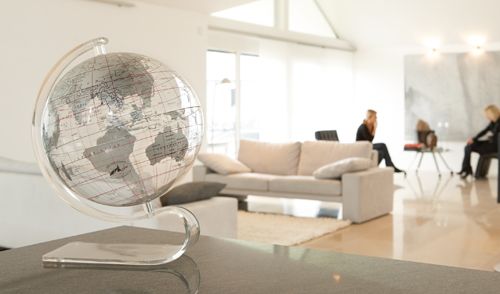
Would Mies van der Rohe buy this globe?
Only now – after college art history courses and years of reading shelter magazines – we expect each object we place in our home or office to reflect the principals of good design. What would Frank Gehry think of it? Would Philip Johnson have put it in his Glass House?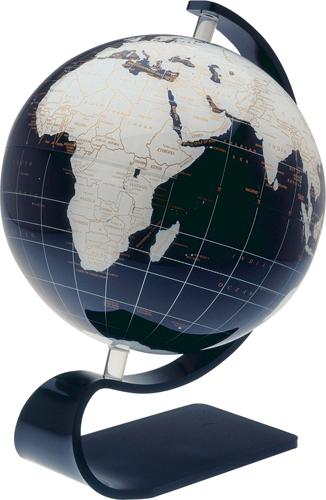
Surely these modern masters would approve of our sleek see-through Earthspheres, cast in heavy acrylic with countries, continents, and other topographical references carefully silk screened on the inside and thus impervious to sticky little fingers.
Several smart colors are available, including an eye-popping red version that is on display at Barney's right now. We prefer the the more understated ones imprinted in matte silver (shown above) or gold, as well as a stunning opaque black and white model that sports silver and gold highlights.
Our globes appear to float – they are mounted on graceful, sculptural pedestal bases of matching acrylic – and are available in two sizes, 12 in. ($295) and 16 in. ($395) in diameter. If making a statement is your thing, you will want our impressive 30 in. globe with floorstand base ($1,499).
These globes make wonderful gifts for the person who has nearly everything, except for, of course, an acrylic earthsphere.
Call or e-mail us for details.
Thursday, June 18, 2009
The High Cost of Buying Cheap
Is it heresy to criticize IKEA? Here's an alternate view from the smart folks at The Atlantic on why shopping there might not be so PC after all:
Everyone loves a bargain, as long as we believe it’s in good taste. And nobody does low-price, high-style better than IKEA, the world’s largest furniture retailer. IKEA passes as the anti-Wal-Mart: a company where value and good values coexist. It uses design as a proxy for quality, and its brand—embodied by all those smiling, white-teethed Scandinavians standing next to smooth, shiny modular furniture with unpronounceable names—as a passport to a guilt-free world of low prices.
But put down your 59-cent Färgrik coffee mug and ask yourself: Can we afford to keep shopping at places where an item’s price reflects only a fraction of its societal costs?
IKEA designs to price, challenging its talented European team to create ever-cheaper objects, and its suppliers—most of them in low-wage countries in Asia and eastern Europe—to squeeze out the lowest possible price. By some measures the world’s third-largest wood consumer, IKEA proudly employs 15 “forestry monitors.” Eight of them work in China and Russia, but illegal logging is widespread in those vast countries, making it impossible to guarantee that all wood is legally harvested. (The company declines to pay a premium to ensure that all timber is legally harvested, citing costs that would be passed along to the consumer.) IKEA furniture made of particleboard and pine is not meant to last a lifetime; indeed, some professional movers decline to guarantee its safe transport. But to be fair, creating heirlooms is not IKEA’s goal. Nor, despite a lot of self-serving hoopla, is energy conservation: the company boasts of illuminating its stores with low-wattage lightbulbs but positions outlets far from city centers, where taxes are low and commuting costs high—the average IKEA customer drives 50 miles round-trip. Cleverly, IKEA transfers transport and energy costs onto consumers, who are then handed the additional burden of assembling their purchases. Designed but not crafted, IKEA bookcases and chairs, like most cheap objects, resist involvement: when they break or malfunction, we tend not to fix them. Rather, we buy new ones. Wig Zamore, a Massachusetts environmental activist who was recently recognized for his work by the Environmental Protection Agency, is working with IKEA and supports some of the company’s regional green initiatives. But as he put it, “IKEA is the least sustainable retailer on the planet.” And in real costs—the kind that will burden our grandchildren—that also makes it among the most expensive.
Ellen Ruppel Shell is an Atlantic contributing editor and the author of Cheap: The High Cost of Discount Culture.
Saturday, June 13, 2009
The Enlightened Traveler: Mexico City – Chic, Cheap, Cool, Close
Why don't more people appreciate the considerable charms of Mexico City?
This 20-million-strong metropolis offers a lot of sophisticated pleasures for the jaded traveler – world class art, museums, restaurants, and more.
It's also cheap, with the added benefit that it's just three hours by air from Los Angeles and less than six hours from New York.
That beats a 20-hour trip to Buenos Aires any day (unless you'd kill for a fresh alfajor or absolutely must have a new custom-fitted lambskin jacket).
The Mexican capital boasts an array of cultural attractions that are as fine as anything you'll see in Europe. It's worth the trip just to visit the spectacular National Museum of Anthropology whose significant archaeological and ethnographic artifacts from pre-Columbian times are displayed superbly in 23 galleries. (Sounds dull, it's anything but!) Allow an entire day or even two. You won't regret it.

You'll marvel at the massive modernist murals by Siquieros, Tamayo, Orozco and Rivera at the Palacio de Bellas Artes in Alameda Park. They stand in stark contrast to the opera house's ornate Beaux Arts interior.
More Rivera murals fill the walls of the Palacio Nacional, the seat of Mexico's government. These depict a panorama of Mexican history from pre-Colombian times, to the Spanish conquest, to Rivera's 1920s Communist vision showing workers listening to Karl Marx. Fascinating stuff.
The colonial Coyoacan quarter is where you'll find the Frida Kahlo Museum (her home and studio) along with several other small museums and plenty of inviting cafes and restaurants. Los Danzantes is a favorite. They distill their own Mezcal. Plan a long, leisurely lunch on their terrace overlooking the historic square's charming gardens.
For food, fun, and shopping, you'll want to focus on Coyoacan, as well as Condesa and Roma.
In arty Condesa (the Notting Hill of Mexico City) the hotel Condesa DF is known for its smart rooms and late-night restaurant and bar scene. Movie star Diego Luna is co-owner of Cafeina, another popular Condesa rendezvous.

In Roma, Casa Lamm's striking setting imposes (successfully!) modern elements on a 1913 mansion. The interior and exterior seemingly form one space and make for a magical evening on a warm night. The fusion cuisine is excellent.
Finally, on Sunday, hire a car to take you to the San Angel crafts market. Then visit the studio designed for Diego Rivera and Frida Kahlo by modernist master Juan O'Gorman. End your afternoon with a drink or late lunch on the patio at the lovely San Angel Inn.
There's lots more to enjoy in Mexico City. Don't take our word for it. Go and find out for yourself.
A few tips to enjoy your visit:
If you're worried about the swine flu, it's now global. Unless you want to stay home for the next year, you might as well go to Mexico. And remember, many times fewer folks have died from the swine flu than do each year from regular flu strains ♦ You'll have a fine time in Mexico City if you observe a few common sense rules. Don't take a taxi unless it's been called for you by your hotel or restaurant ♦ Leave your good jewelry and watches at home ♦ For more on sites associated with Kahlo and Rivera, click here ♦ And, as always, wearing white sneakers is a sure giveaway that you're an American tourist
Wednesday, June 10, 2009
“I still have my feet on the ground, I just wear better shoes.” ~ Oprah Winfrey
 Good morning, boys and girls. Today's lesson is about shoes.
Oh, not just any shoes. These are very special shoes – works of art, really – fashioned from the finest, softest Italian leathers. And in such pretty colors, too!
Rock stars, movie stars, athletes, and other famous people wear them. We've heard that even TV stars wear them. Wouldn't these make wonderful gifts for Emmy and Oscar winners? Yes, they would!
Did we tell you that they are made by hand right here in Southern California? That is correct – entirely by hand to your measurements and choice of details.
There are lots of styles for daddies... ...and for mommies, too.
Who does such exquisite, sublime work? Why, George Esquivel, that's who.
If you've never heard of him, that's because he's (1) exclusive and (2) expensive. Ask your parents to explain this to you.
Or call (310) 581-6710 and speak with the nice people at Jasper & James.
Thank you, children. I'll see you after recess.
Saturday, June 6, 2009
Thinking Japanese
In a recent column for the Financial Times, cultural observer Tyler Brûlé described five Japanese concepts that should be exported.
1. The ‘ice-type’ facial wipe
As the mercury creeps upwards with the arrival of summer, the “ice-type” facial wipe starts to appear in convenience stores and pharmacies across the country. Not to be confused with the basic face wipe, which simply cleanses, the menthol version is close to being an anaesthetic in tissue form and can instantly transform a sweaty, blushed complexion into a visage of chilly, collected calm. The best brand on the market is Osaka-based Mandom’s Gatsby range.
2. Muji – the real version
The Japanese retailer needs to stop watering down its international offer and deliver the same experience to shoppers in London and Paris that it does in Osaka and Tokyo. The world is waiting for Muji houses, a bigger bicycle range, restaurants and its Labo fashion collection.
3. Clever collaborations
Japanese consumers love a clever tie-up between established brands and smart creative talent. Good examples are retailer Beams doing a customised Subaru in hot orange and chocolate brown, or bagmaker Porter doing a “man bag” exclusively for ANA.
4. Travel etiquette
Japan could educate other countries in the fine art of getting passengers on to large and small aircraft without ever creating a queue in the boarding bridge. This is a facet of daily life that continues to amaze me and could save billions in delayed departure times and lost hours of productivity.
5. Bathroom culture
The Washlet (the automated, all- spraying, all-blow-drying, all-sound cancelling, all-deodorising toilet) is finally making inroads into new markets, but the world needs to embrace this concept faster. If it’s standard practice to wash your hands after going to bathroom, shouldn’t it also be part of the routine to wash the parts of your body that performed the function? Japan’s become so addicted that they’ll even feature on the two national carriers’ 787s when they eventually take to the skies.
The Annals of Luxury: A Peek Inside Vuitton
Exactly what is the difference between a $1,500 Louis Vuitton bag and and a Santee Alley knockoff?
If you thought we were going to say that you can't tell them apart, dream on!
Of course there's a big difference. Highly skilled craftsmanship and quality materials are just the start.
Take a look inside Vuitton's spotless 150-year-old workshops in Asnieres-sur-Seine, France, to see some of what else you're paying for. This is where Vuitton makes its custom orders. You don't see factories like this in China, do you?
(The video, from the French business newspaper Les Echos, is in French, but the head of Vuitton isn't saying anything you don't already know about his historic firm. The pictures are what's important.)
All of this comes at a price.
Still, is that $6,000 Birkin really worth it, given that Vuitton is charging you 12 or 13 times the cost of making it? Or to put it another way, the $995 Papillion that you covet was made for about $80.
(If General Motors had margins like that, they would be bailing us out. But this is another story.)
Vuitton isn't alone in claiming these giant markups. The same goes for other Rodeo Dr. brands.
The value of any luxury item lies in the eyes of the consumer. It has to do with the difference between wants vs. needs, as we have learned from years of sales training on two continents. And then there's the notion of "perceived value." If you think it's worth $6,000, it is.
Does the bag represent good value for the money? Of course, not! But then if you can afford it, you might not care. So go for it!
Just make sure to pay your bills and take care of all the little people in your life first, before blowing all of your cash on something you merely "want."
Saturday, May 30, 2009
Father's Day is June 21, and Dad Needs a Cartier Pen
Pop's a cool guy, right? So give him a Father's Day gift that he'll use every day – and think of you when he does.
We recommend Cartier's famous Diabolo ballpoints, rollerballs, and fountain pens. A gift of one of these fine writing instruments – with their excellent performance on the page, streamline Art Deco-inspired design, and signature blue cabochon tipped caps – will tell dad how much you appreciate everything he has and continues to do for you.
Several styles and colors are available, starting at $295. One of our favorites is this handsome Diabolo in blue lacquer with platinum accents:

Your choice of ballpoint ($410), rollerball ($455) or fountain pen with 18kt gold nib ($610).
It's also available in black with gold or platinum accents:
These start at $315 for the ballpoint.
If Dad works in the movie or music business, then you're going to want one of Cartier's limited edition Cinema (just out) or Rock & Roll models:
We we offer three Cinema motifs – 35mm film (shown), clapper and "The End" – starting at $670 and in ballpoint only:
Cartier introduced the Rock & Roll pens in 2007. There are only a few left. This beauty with a guitar on the clip is $750.
There are several other music themed designs, as well.
All Cartier pens come in the jeweler's impressive signature red gift box.
We offer these and other Cartier pens by special order only. Please call us at (310) 581-6710 well before Father's Day to avoid disappointment.
We also carry fine pens from other makers, including Dunhill, Delta, Conway Stewart, Visconti, Omas, Porsche, Pelikan, Michel Perchin, and many others.
For more gift ideas, click right here.
Tuesday, May 26, 2009
The Annals of Luxury: Bling Goes Bust
No doubt wishing that they hadn't spent all that money doing you know what, many rappers and their followers no longer have the cash for flash. Those gaudy necklaces and brazen adornments are too costly, reports the Wall St. Journal.
"The recession is cramping the style of hip-hop artists and wannabes – many of whom are finding it difficult to afford the diamond-encrusted pendants and heavy gold chains they have long used to project an aura of outsized wealth," says the Journal.
Rather than forsake their flamboyant folderol altogether, some celebs are quietly asking their jewelers to use cubic zirconia and less precious metals and stones.
"Hip-hop luminaries with the cash to keep it real are appalled," the Journal adds.
And you think you have problems?
If you want to know who's flush and who's flat broke, read all about it here.
Saturday, May 23, 2009
New! Silk Robes by Taryn Rose

Ten years ago Carol took a chance on a pair of shoes by an unknown designer named Taryn Rose. Though they were expensive, Carol bought them because she knew that Nordstrom would stand behind the brand.
Flash forward a decade. She still wears her Taryn Rose loafers, the most comfortable shoes she owns. And they look as if they were designed just yesterday.
Taryn Rose is now a well regarded luxury brand, with boutiques in Beverly Hills and New York and carried by top merchants like Saks, Neiman-Marcus, Harrod's and many others.
We are pleased to report that the designer has just launched a new line of chic robes fashioned from yummy silk charmeuse. These richly colored, two-tone garments (like the one show here in two shades of blue) are reversible.
Inspired by Hollywood screen legends whose names they bear – Rita, Audrey, and Marilyn – these are chic pieces that go from night wear to night club in style when you add a mini skirt or pair of skinny jeans.
Bones & Roses robes are just hitting shops and are a bit hard to find. Can't wait for yours? Call us at (310) 581-6710 and we'll point you in the right direction.
$225. S, M, L. By special order only. Please ask us about colors and styles currently available.
For more gift ideas, click right here.
Wednesday, May 20, 2009
Miss Whistle, PG, and the Wayward Fax
What brand of tea is the most satisfying regardless of price? For our money, it's PG Tips.
We've been enjoying it daily for 20 years now and still prefer it to all others. The British do, too; it's the most popular tea in England. And it's not expensive at all.

We were introduced to it long ago by our English secretary, the capable, accomplished and good natured Miss Whistle. That is just one of many things for which we will ever be grateful to her.
(Another is the time she cried on the phone to a complete stranger to retrieve a fax that we mistakenly had sent to the wrong party and which would have compromised us had it fallen into unworthy hands. Of course that was the year we got our first fax machine and were unaware of the damage it could inflict–on us. What an unfortunate mess might have resulted were it not for the courageous Miss Whistle! But we digress.)
PG isn't what you call a gourmet product. Britons of all classes consume large amounts of it with regularity. We've tried more expensive teas, but none is as pleasurable or as comforting as dear old PG.
In the U.S. you'll find PG at better markets and wherever British products are sold. (A note of warning: Be sure to check the expiration date on the package for freshness.)
Here are a few pointers for making a good cup of tea:
- For a smooth, full taste start with cold filtered water
- Always warm the pot for a short while with some hot water; then throw it out, put your PG in the pot and refill with hot water
- The water you use should be very hot but not boiling; let it come to a full boil; turn off the heat and wait a few seconds before making tea
- Warm your cups, too, with hot water before pouring your tea
- If you take milk, as the British do, warm it in a small pan or the microwave until its scalding but do not let it boil; and never use cold milk from the fridge in your tea; that's a no no!
And now, something for the kiddies:
Saturday, May 16, 2009
Those Were the Glory Days!
The Cannes festival started on Wednesday night. We look back at the Cannes that was.
Thursday, May 14, 2009

Saturday, May 9, 2009
The Enlightened Traveler: Santa Monica's Main St.
The tourists flock to the Third St. Promenade. Those of us who live in Santa Monica go elsewhere to dine and shop. Main St., for example.
We're pleased to see that the "wrong end" of the avenue (the stretch north of Ocean Park Blvd.) is getting a bit more interesting at last.
This morning we strolled over – with our cousins from Santa Barbara who were under mandatory evacuation orders due to the Jesusita fires – to the new La Grande Orange cafe and enjoyed a splendid breakfast. It was a "soft" opening (invited guests only) intended to give the kitchen and wait staff a trial run.  Judging from the tasty food and friendly, efficient service, they don't need any more practice. They should just open the place and brace themselves for the hordes that will descend.
We loved their perfectly timed and presented soft-boiled eggs, wonderful muffins and other baked goods, housemade muesli, and especially their Lemon Skinny, a dinner plate sized crepe-like pancake second only to Musso & Frank's famous flannel cakes, a perennial favorite of ours.
The dining room is spacious and comfortable with a pleasant terrace on two sides. There's also a cozy wine bar featuring a small selection of Santa Barbara labels.
After your meal stop in a few doors further north at Goudas & Vines to inspect their ample array of wines and imported foods, including MarieBelle hot chocolate mix (another favorite), Ravida and other premium olive oils, and a good deal more.
As for La Grande Orange, breakfast is served from 6:30 daily. It's open for lunch and dinner till 11pm weeknights and later on the weekends. Open for business starting Tuesday, May 12.
We'll be back, and often.
La Grande Orange, 2000 Main St., Santa Monica,
(310) 396-9152


 Posts
Posts


