The great jazz pianist and whispy-voiced chanteuse Blossom Dearie, who died earlier this year, was known for her expert musicianship and casual sophistication.
She often took a nonchalant approach to lyrics with dryly humorous renditions of the two Dave Frishberg tunes "I'm Hip" and "Peel Me a Grape" and a breezy version of the Arthur Schwartz-Howard Dietz number, "Rhode Island Is Famous For You."
That song, a panegyric to the Lower 48, contains one of our favorite verses:
Ol' whiskey comes from ol' Kentucky
Ain't the country lucky?
New Jersey gives us glue
And you, you come from Rhode Island
And little ol' Rhode Island is famous for you!
(You can listen to Blossom Dearie's complete recording here.)
Which brings us to another of that state's celebrities, designer Jay Strongwater.
From his Rhode Island workshops, Strongwater fabricates exquisite picture frames (like the orchid and palm model shown here) that sparkle with crystals and bold colors. He also creates fanciful clocks, vases, figurines, lighting, and other art objects for the home.
Each piece is ornately hand enameled. Strongwater is partial to nature imagery – leaves, flowers, coral, animals, insects, and sea shells.
The other day, we chatted briefly with the designer who gave us a preview of his Fall collection. We were particularly impressed by this desktop clock in the shape of a squirrel with an acorn.
What time is it? Open the top of the acorn to reveal the clock.
This sensational draped table mirror knocked us out...
...as did these chrysanthemum and lacewing picture frames. Strongwater's Menorah will be available in time for Hanukkah, which starts on December 11. (Be prepared, the Festival of Lights arrives early this year.)
Not new this season but one of our favorites is this gingko vase made of luminous earth-toned Portuguese glass with hand-painted enamel and metal leaves and a dragonfly. There's certain to be a Strongwater objet that each of your Emmy and Oscar nominees and winners, valued clients, and cherished loved ones will adore. Please ask us to help you select the perfect one. We are at (310) 581-6710.
Thursday, July 23, 2009
Rhode Island Is Famous For Jay Strongwater. We Preview His Impressive New Collection


Tuesday, July 21, 2009
The Enlightened Traveler: Buenos Aires –
There's More to the Capital Than Tango
To hear visitors tell it, you'd think that there is no other music in Argentina but tango.
While we love the national art form as much as the next guy, at times we want something different – which is why when we are in Buenos Aires we're happy to spend a mellow evening listening to jazz at Notorious.
It's a memorable experience. For one thing, the cozy night spot is tucked away behind a record store on busy Av. Callao. From the street, you wouldn't know the club is there. You walk through bins of CDs to a small opening at the rear.
Surprise! This is a great jazz club.
It's a simple affair, an intimate black box really. All of the tables are close to the "stage." Young, sophisticated Portenos (what the residents of Buenos Aires call themselves) make up the crowd.
You'll hear mostly local musicians – albeit very accomplished ones – with an occasional gig by an internationally known name. One night we enjoyed a mellow Chet Baker-like set from the trumpeter Roberto Fats Fernandez. When we mentioned this to one of our Argentine friends, he exclaimed, "Fats Fernandez has played in New York, you know!"
What will your night out cost? About US$5 for admission. A plate of charcuterie with a baguette (enough for two) and a couple of beers will set you back another US$10.
A great night out, and the price is right!
Notorious is located at Av. Callao 966 (a few minutes by cab from Recoleta). Telephone 4816 2888. www.notorious.com.ar
Monday, July 13, 2009
Things Not Available in the U.S.:
Philips 21:9 True Widescreen TV
A few years ago, you were in the vanguard if your TV had a 16:9 aspect ratio screen. Today, that's the norm, allowing you to watch most movies more or less in their original format.
But if you want to watch widescreen movies at home, you have to put up with those annoying black bars at the top and bottom of the screen.
Philips has solved this problem with the introduction of its 56 in. Cinema 21:9 HDTV, the first set with the same spectacular 2.35:1 aspect ratio as today's biggest films. Think Michael Mann's new Public Enemies or Harry Potter and the Half-Blood Prince.
The set also has a record number of pixels, at 8.3 million. To get the full benefit you'll want to play movies recorded on Blu-ray discs.
Philips hasn't set a release date yet. They have announced the price, about US$7,400.
The British TechRadar website said: "Four and a half grand [in UK£] is a lot of money, but then this is, in every sense, a lot of telly.
"If you are serious about video quality and have a substantial budget, then this set should be at the very top of your list."
The review added that the picture quality is "remarkable."
Sadly, Philips says they won't be selling the TV in the U.S. or Canada. Just in Europe for now.
Read more here.
Wednesday, July 8, 2009
The Annals of Luxury: Premium Wine Prices Falling
 Americans are forsaking premium wines and buying more mid- and low-priced wines, reports today's Wall St. Journal. Sales of wines priced above $25 per bottle slumped 12% in the first quarter.
Boutique wineries – those that make $100 per bottle cabs, for example – are seeing sharper drops of up to 40%. How much are they suffering? Auction Napa Valley, the industry's annual event, raised $5.7 million last month, down from $10.4 million last year.
While winemakers are feeling the heat, consumers are benefiting from lower prices on top bottles. If you've got money to splurge, now is the time to stock up on pricey domestic cabs and meritages.
The full report is here.
Friday, July 3, 2009
The Grill of Your Dreams
 Cooking food out of doors over glowing embers is one of summer's great pleasures.
If you're more into Bauhaus than Beaux Arts, have we got a grill for you!
This lustrous all-stainless steel beauty was designed and is manufactured in Denmark. You'll admire its sleek, architectural lines while waiting for your steak to reach medium rare.
The generous 23 in. diameter cooking surface is large enough to prepare food for up to six guests.
After dinner, throw on a few logs and your barbecue becomes a welcoming hearth. (All the more inviting if you break out a bottle of vintage port or premium Scotch, along with a couple of good cigars.)
An optional dome lid is available for indirect cooking, as is a custom fitted cover that will keep the stainless steel looking good for many years.
At $1,890 there are less expensive barbecues. But if you're the kind of person who knows the difference between Philip Johnson and Don Johnson, then you gotta have this.
Special order only. Allow 4-6 weeks for delivery. To make sure you get yours in time for Labor Day, call us now at (310) 581-6710.
A Sweet, Chic Alternative
If you're a design snob on a budget, the same Danish team has come up with this nifty porcelain table top grill.
It's perfect for intimate dinners on the terrace or for an impromptu picnic at the beach or park. The practical handle makes it easy to carry anywhere, everywhere.
Available in white or black. $350. Also special order only.
Tuesday, June 30, 2009
...And The Livin' Is Easy
We're having a nice winter here in Santa Monica this summer.
It's the end of the month, and our famous June Gloom shows no signs of letting up. If you're planning a trip our way, bring a sweater!
It's much more temperate elsewhere in the Northern Hemisphere. England is enjoying 80º weather this Wimbledon week. Even Rio de Janeiro is ten degrees warmer than Santa Monica, and that's in the Southern Hemisphere.
On the proposition that it's got to be hot and sultry somewhere in the world at any given moment, we offer recipes for these fast, uncommon thirst quenchers, courtesy of hooch hotshot Derek Brown and The Atlantic's excellent food blog.
Easy Mixing: 5 Cocktails for the Lazy

I don't get the chance to be lazy too often. My workweek is frequently seven days long. Come Sunday afternoon I'm writing, preparing for an event, or responding to emails. Thankfully, I love what I do and, being that my job is what it is, I get to go out to bars and restaurants often. So it's not all that bad.
Yet the feeling of swinging in a hammock, beneath the fiery mid-day sun with an ice-cold drink sweating in the palm of my hand and the intermittent sips the only thing keeping me from melting in to a pile of flesh and bones, beckons as the summer advances. Being lazy feels good.
So while I usually caution readers to take care in crafting cocktails, this time I'm going to call for a different tact: be lazy. Below are some of my favorite drinks for the shiftless, idle and indolent. They go for simplicity and ease:
Let's start with the Cheribita. Supposedly a British invention in Spain, the Cheribita doesn't even require you to lift a full bottle. Buy a half bottle of fino sherry (dry sherry) and a bottle of orange bitters. Pour sherry over ice and add two dashes of bitters. Stir with your finger.
The Dark and Stormy is the national drink of Bermuda. The hardest part of making a Dark and Stormy is finding ginger beer. (Barritts is from Bermuda and is the ginger beer most commonly called for.) Leave off the lime and mix at two to one, ginger beer to Goslings Dark Rum. Add ice. Done.
White Port and tonic is a Portuguese favorite. Mine too. The tonic balances the sweetness of the Port and makes an easy blend at almost any ratio. Pour the Port over ice and top with tonic. Ah, summer.
The Ice Pick is genius. It mixes vodka with ice tea, so you can tell your significant other that it's just ice tea, and you'll get back to Sunday afternoon chores after a short break. Don't bother eyeing or measuring. Make a pitcher of tea. Pour vodka to taste. Avoid heavy machinery.
The Rickey is a drink you're going to hear a lot about from me. It's Washington, D.C.'s native cocktail. You can use any spirit you wish (gin is the most popular). Pour in a shot. Squeeze half of a lime and drop it in the glass. Add ice and soda. Kick back and feel the breeze.
Enjoy.
Thursday, June 25, 2009
Put a Libeskind in Your Driveway
For folks who really do have everything, here’s something you don’t see every day – a contemporary home dreamed up by Daniel Libeskind, the designer of such high profile projects as the Jewish Museum Berlin and the master plan for the World Trade Center site.
With dramatic sharp, pointed angles, expansive floor-to-ceiling windows throughout, and an exterior clad in zinc, the 5,500 sq. ft. villa isn’t your average split level. The home’s strong geometries allow for an asymmetrical interior of spiraling, two-story peaks. The entrance hall leads to an elaborate Grand Room with a kitchen at one end. Also included: four bedrooms, family room, office, and a basement sauna and wine cellar.
The elegant zinc façade enables the use of 21st Century technologies such as a solar thermal system and a rain water harvesting system.
Libeskind says the villa, which is manufactured in Germany, can be shipped and assembled anywhere in the world within months and will be assembled on location by a team of experts within weeks. The price of all this fashionable luxury? $2.8 million to $4.2 million, depending on your location. Of course, this does not include the cost of your lot. Add another $500,000 if you live in Baltimore, or $5 million if you prefer Bel Air.
For that you get “regional exclusivity,” which means that the celebrity down the street cannot have one like yours.
While he has designed museums, universities, hotels and other major cultural and commercial buildings, Libeskind has designed only a couple of individual homes before this.
Now’s your chance. Get one while you can!
For more on the Libeskind villa:
www.libeskind-villa.com
www.daniel-libeskind.com
Wednesday, June 24, 2009
Things Not Available in the U.S.: Alfa Romeo Mito
Alfa Romeo's pint-sized city car, the Mito, looks anything but. We want this car, and we want it bad. Sadly, it's not for sale here.
Sunday, June 21, 2009
As The World Turns, And Turns, And Turns...
Remember the globes we had when we were kids – those sickly turquoise colored numbers, printed on cheap paper, the whole thing covered with a thin coating of varnish that yellowed with age?
We are not 11 anymore. But we still consult our globe to track the geo-political implications of each day's headlines.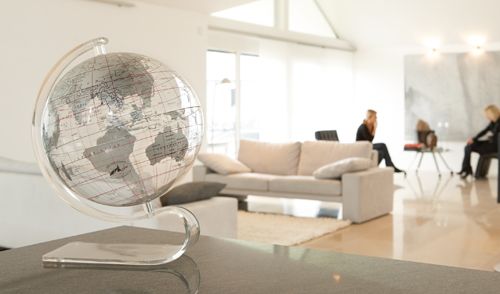
Would Mies van der Rohe buy this globe?
Only now – after college art history courses and years of reading shelter magazines – we expect each object we place in our home or office to reflect the principals of good design. What would Frank Gehry think of it? Would Philip Johnson have put it in his Glass House?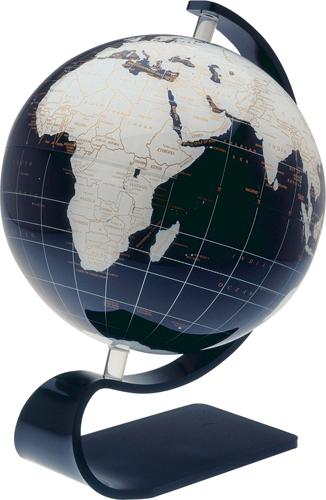
Surely these modern masters would approve of our sleek see-through Earthspheres, cast in heavy acrylic with countries, continents, and other topographical references carefully silk screened on the inside and thus impervious to sticky little fingers.
Several smart colors are available, including an eye-popping red version that is on display at Barney's right now. We prefer the the more understated ones imprinted in matte silver (shown above) or gold, as well as a stunning opaque black and white model that sports silver and gold highlights.
Our globes appear to float – they are mounted on graceful, sculptural pedestal bases of matching acrylic – and are available in two sizes, 12 in. ($295) and 16 in. ($395) in diameter. If making a statement is your thing, you will want our impressive 30 in. globe with floorstand base ($1,499).
These globes make wonderful gifts for the person who has nearly everything, except for, of course, an acrylic earthsphere.
Call or e-mail us for details.
Thursday, June 18, 2009
The High Cost of Buying Cheap
Is it heresy to criticize IKEA? Here's an alternate view from the smart folks at The Atlantic on why shopping there might not be so PC after all:
Everyone loves a bargain, as long as we believe it’s in good taste. And nobody does low-price, high-style better than IKEA, the world’s largest furniture retailer. IKEA passes as the anti-Wal-Mart: a company where value and good values coexist. It uses design as a proxy for quality, and its brand—embodied by all those smiling, white-teethed Scandinavians standing next to smooth, shiny modular furniture with unpronounceable names—as a passport to a guilt-free world of low prices.
But put down your 59-cent Färgrik coffee mug and ask yourself: Can we afford to keep shopping at places where an item’s price reflects only a fraction of its societal costs?
IKEA designs to price, challenging its talented European team to create ever-cheaper objects, and its suppliers—most of them in low-wage countries in Asia and eastern Europe—to squeeze out the lowest possible price. By some measures the world’s third-largest wood consumer, IKEA proudly employs 15 “forestry monitors.” Eight of them work in China and Russia, but illegal logging is widespread in those vast countries, making it impossible to guarantee that all wood is legally harvested. (The company declines to pay a premium to ensure that all timber is legally harvested, citing costs that would be passed along to the consumer.) IKEA furniture made of particleboard and pine is not meant to last a lifetime; indeed, some professional movers decline to guarantee its safe transport. But to be fair, creating heirlooms is not IKEA’s goal. Nor, despite a lot of self-serving hoopla, is energy conservation: the company boasts of illuminating its stores with low-wattage lightbulbs but positions outlets far from city centers, where taxes are low and commuting costs high—the average IKEA customer drives 50 miles round-trip. Cleverly, IKEA transfers transport and energy costs onto consumers, who are then handed the additional burden of assembling their purchases. Designed but not crafted, IKEA bookcases and chairs, like most cheap objects, resist involvement: when they break or malfunction, we tend not to fix them. Rather, we buy new ones. Wig Zamore, a Massachusetts environmental activist who was recently recognized for his work by the Environmental Protection Agency, is working with IKEA and supports some of the company’s regional green initiatives. But as he put it, “IKEA is the least sustainable retailer on the planet.” And in real costs—the kind that will burden our grandchildren—that also makes it among the most expensive.
Ellen Ruppel Shell is an Atlantic contributing editor and the author of Cheap: The High Cost of Discount Culture.
Saturday, June 13, 2009
The Enlightened Traveler: Mexico City – Chic, Cheap, Cool, Close
Why don't more people appreciate the considerable charms of Mexico City?
This 20-million-strong metropolis offers a lot of sophisticated pleasures for the jaded traveler – world class art, museums, restaurants, and more.
It's also cheap, with the added benefit that it's just three hours by air from Los Angeles and less than six hours from New York.
That beats a 20-hour trip to Buenos Aires any day (unless you'd kill for a fresh alfajor or absolutely must have a new custom-fitted lambskin jacket).
The Mexican capital boasts an array of cultural attractions that are as fine as anything you'll see in Europe. It's worth the trip just to visit the spectacular National Museum of Anthropology whose significant archaeological and ethnographic artifacts from pre-Columbian times are displayed superbly in 23 galleries. (Sounds dull, it's anything but!) Allow an entire day or even two. You won't regret it.

You'll marvel at the massive modernist murals by Siquieros, Tamayo, Orozco and Rivera at the Palacio de Bellas Artes in Alameda Park. They stand in stark contrast to the opera house's ornate Beaux Arts interior.
More Rivera murals fill the walls of the Palacio Nacional, the seat of Mexico's government. These depict a panorama of Mexican history from pre-Colombian times, to the Spanish conquest, to Rivera's 1920s Communist vision showing workers listening to Karl Marx. Fascinating stuff.
The colonial Coyoacan quarter is where you'll find the Frida Kahlo Museum (her home and studio) along with several other small museums and plenty of inviting cafes and restaurants. Los Danzantes is a favorite. They distill their own Mezcal. Plan a long, leisurely lunch on their terrace overlooking the historic square's charming gardens.
For food, fun, and shopping, you'll want to focus on Coyoacan, as well as Condesa and Roma.
In arty Condesa (the Notting Hill of Mexico City) the hotel Condesa DF is known for its smart rooms and late-night restaurant and bar scene. Movie star Diego Luna is co-owner of Cafeina, another popular Condesa rendezvous.

In Roma, Casa Lamm's striking setting imposes (successfully!) modern elements on a 1913 mansion. The interior and exterior seemingly form one space and make for a magical evening on a warm night. The fusion cuisine is excellent.
Finally, on Sunday, hire a car to take you to the San Angel crafts market. Then visit the studio designed for Diego Rivera and Frida Kahlo by modernist master Juan O'Gorman. End your afternoon with a drink or late lunch on the patio at the lovely San Angel Inn.
There's lots more to enjoy in Mexico City. Don't take our word for it. Go and find out for yourself.
A few tips to enjoy your visit:
If you're worried about the swine flu, it's now global. Unless you want to stay home for the next year, you might as well go to Mexico. And remember, many times fewer folks have died from the swine flu than do each year from regular flu strains ♦ You'll have a fine time in Mexico City if you observe a few common sense rules. Don't take a taxi unless it's been called for you by your hotel or restaurant ♦ Leave your good jewelry and watches at home ♦ For more on sites associated with Kahlo and Rivera, click here ♦ And, as always, wearing white sneakers is a sure giveaway that you're an American tourist
Wednesday, June 10, 2009
“I still have my feet on the ground, I just wear better shoes.” ~ Oprah Winfrey
 Good morning, boys and girls. Today's lesson is about shoes.
Oh, not just any shoes. These are very special shoes – works of art, really – fashioned from the finest, softest Italian leathers. And in such pretty colors, too!
Rock stars, movie stars, athletes, and other famous people wear them. We've heard that even TV stars wear them. Wouldn't these make wonderful gifts for Emmy and Oscar winners? Yes, they would!
Did we tell you that they are made by hand right here in Southern California? That is correct – entirely by hand to your measurements and choice of details.
There are lots of styles for daddies... ...and for mommies, too.
Who does such exquisite, sublime work? Why, George Esquivel, that's who.
If you've never heard of him, that's because he's (1) exclusive and (2) expensive. Ask your parents to explain this to you.
Or call (310) 581-6710 and speak with the nice people at Jasper & James.
Thank you, children. I'll see you after recess.
Saturday, June 6, 2009
Thinking Japanese
In a recent column for the Financial Times, cultural observer Tyler Brûlé described five Japanese concepts that should be exported.
1. The ‘ice-type’ facial wipe
As the mercury creeps upwards with the arrival of summer, the “ice-type” facial wipe starts to appear in convenience stores and pharmacies across the country. Not to be confused with the basic face wipe, which simply cleanses, the menthol version is close to being an anaesthetic in tissue form and can instantly transform a sweaty, blushed complexion into a visage of chilly, collected calm. The best brand on the market is Osaka-based Mandom’s Gatsby range.
2. Muji – the real version
The Japanese retailer needs to stop watering down its international offer and deliver the same experience to shoppers in London and Paris that it does in Osaka and Tokyo. The world is waiting for Muji houses, a bigger bicycle range, restaurants and its Labo fashion collection.
3. Clever collaborations
Japanese consumers love a clever tie-up between established brands and smart creative talent. Good examples are retailer Beams doing a customised Subaru in hot orange and chocolate brown, or bagmaker Porter doing a “man bag” exclusively for ANA.
4. Travel etiquette
Japan could educate other countries in the fine art of getting passengers on to large and small aircraft without ever creating a queue in the boarding bridge. This is a facet of daily life that continues to amaze me and could save billions in delayed departure times and lost hours of productivity.
5. Bathroom culture
The Washlet (the automated, all- spraying, all-blow-drying, all-sound cancelling, all-deodorising toilet) is finally making inroads into new markets, but the world needs to embrace this concept faster. If it’s standard practice to wash your hands after going to bathroom, shouldn’t it also be part of the routine to wash the parts of your body that performed the function? Japan’s become so addicted that they’ll even feature on the two national carriers’ 787s when they eventually take to the skies.
The Annals of Luxury: A Peek Inside Vuitton
Exactly what is the difference between a $1,500 Louis Vuitton bag and and a Santee Alley knockoff?
If you thought we were going to say that you can't tell them apart, dream on!
Of course there's a big difference. Highly skilled craftsmanship and quality materials are just the start.
Take a look inside Vuitton's spotless 150-year-old workshops in Asnieres-sur-Seine, France, to see some of what else you're paying for. This is where Vuitton makes its custom orders. You don't see factories like this in China, do you?
(The video, from the French business newspaper Les Echos, is in French, but the head of Vuitton isn't saying anything you don't already know about his historic firm. The pictures are what's important.)
All of this comes at a price.
Still, is that $6,000 Birkin really worth it, given that Vuitton is charging you 12 or 13 times the cost of making it? Or to put it another way, the $995 Papillion that you covet was made for about $80.
(If General Motors had margins like that, they would be bailing us out. But this is another story.)
Vuitton isn't alone in claiming these giant markups. The same goes for other Rodeo Dr. brands.
The value of any luxury item lies in the eyes of the consumer. It has to do with the difference between wants vs. needs, as we have learned from years of sales training on two continents. And then there's the notion of "perceived value." If you think it's worth $6,000, it is.
Does the bag represent good value for the money? Of course, not! But then if you can afford it, you might not care. So go for it!
Just make sure to pay your bills and take care of all the little people in your life first, before blowing all of your cash on something you merely "want."
Saturday, May 30, 2009
Father's Day is June 21, and Dad Needs a Cartier Pen
Pop's a cool guy, right? So give him a Father's Day gift that he'll use every day – and think of you when he does.
We recommend Cartier's famous Diabolo ballpoints, rollerballs, and fountain pens. A gift of one of these fine writing instruments – with their excellent performance on the page, streamline Art Deco-inspired design, and signature blue cabochon tipped caps – will tell dad how much you appreciate everything he has and continues to do for you.
Several styles and colors are available, starting at $295. One of our favorites is this handsome Diabolo in blue lacquer with platinum accents:

Your choice of ballpoint ($410), rollerball ($455) or fountain pen with 18kt gold nib ($610).
It's also available in black with gold or platinum accents:
These start at $315 for the ballpoint.
If Dad works in the movie or music business, then you're going to want one of Cartier's limited edition Cinema (just out) or Rock & Roll models:
We we offer three Cinema motifs – 35mm film (shown), clapper and "The End" – starting at $670 and in ballpoint only:
Cartier introduced the Rock & Roll pens in 2007. There are only a few left. This beauty with a guitar on the clip is $750.
There are several other music themed designs, as well.
All Cartier pens come in the jeweler's impressive signature red gift box.
We offer these and other Cartier pens by special order only. Please call us at (310) 581-6710 well before Father's Day to avoid disappointment.
We also carry fine pens from other makers, including Dunhill, Delta, Conway Stewart, Visconti, Omas, Porsche, Pelikan, Michel Perchin, and many others.
For more gift ideas, click right here.


 Posts
Posts


